
Pet food packaging can contain a lot of information. There may be claims about natural ingredients, premium recipes, high meat content, functional benefits or special processing methods.
But if you really want to understand what is inside a pet food or treat, one of the best places to start is the pet food ingredients list.
At Petoody, ingredient transparency is an important part of what we mean by clean pet food. We look for products with recognisable ingredients, thoughtful recipes and minimal unnecessary extras.
That does not mean every ingredient needs to sound like something you would find in your kitchen. Some ingredients serve important nutritional or functional purposes. Instead, the goal is to understand what is in the product, why it is there and whether it makes sense for your pet.
Here is how to take a closer look.
1. Start with the ingredient list, not the front of the packet
The front of a packet is designed to tell you about the product quickly. You might see words such as:
- natural
- premium
- high protein
- grain free
- air dried
- raw
- sensitive
- with real meat
These descriptions can provide useful information, but they do not tell you everything about the recipe.
Turn the packet around and find the actual ingredient list.
This is where you can start answering more useful questions:
What is the food actually made from?
Can I identify the main ingredients?
Are there ingredients I wasn’t expecting?
Does the recipe make sense for the animal being fed?
For example, a dog or cat treat might be predominantly meat, fish or organs, while a treat intended for a rabbit or guinea pig might appropriately be based around hay, grasses and herbs.
Clean pet food is not about applying exactly the same ingredient rules to every species. It is about looking for ingredients that make sense for the animal and the purpose of the product.
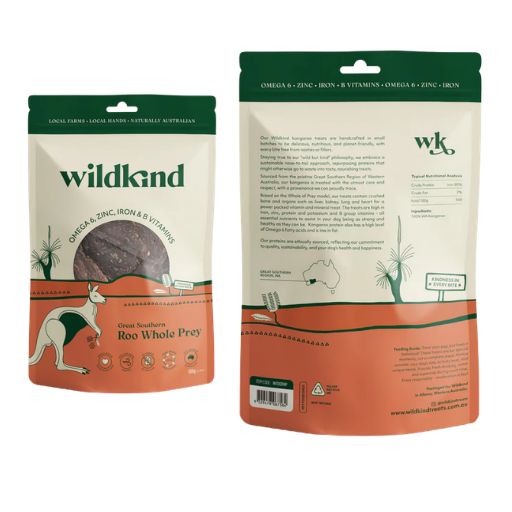
Image: Wild Kind Front and Back of packaging
2. Look at the ingredients in order
In Australia, pet food labelling guidance states that ingredients should be listed in descending order by weight, which means the ingredients appearing near the beginning of the list make up a larger proportion of the recipe.
That makes the first few ingredients a useful place to look.
For a meat-based dog or cat product, you might expect to see ingredients such as:
- chicken
- beef
- kangaroo
- lamb
- fish
- liver
- heart
For rabbits and guinea pigs, ingredients such as:
- hay
- grasses
- timothy
- herbs
- dried plants
may be more appropriate depending on the product.
However, don’t judge a food entirely by its first ingredient.
Fresh meat contains a lot of moisture, for example, so its position in an ingredient list cannot always be directly compared with a dried ingredient. Processing also changes the final concentration of ingredients.
Think of ingredient order as one piece of information rather than a complete quality score.
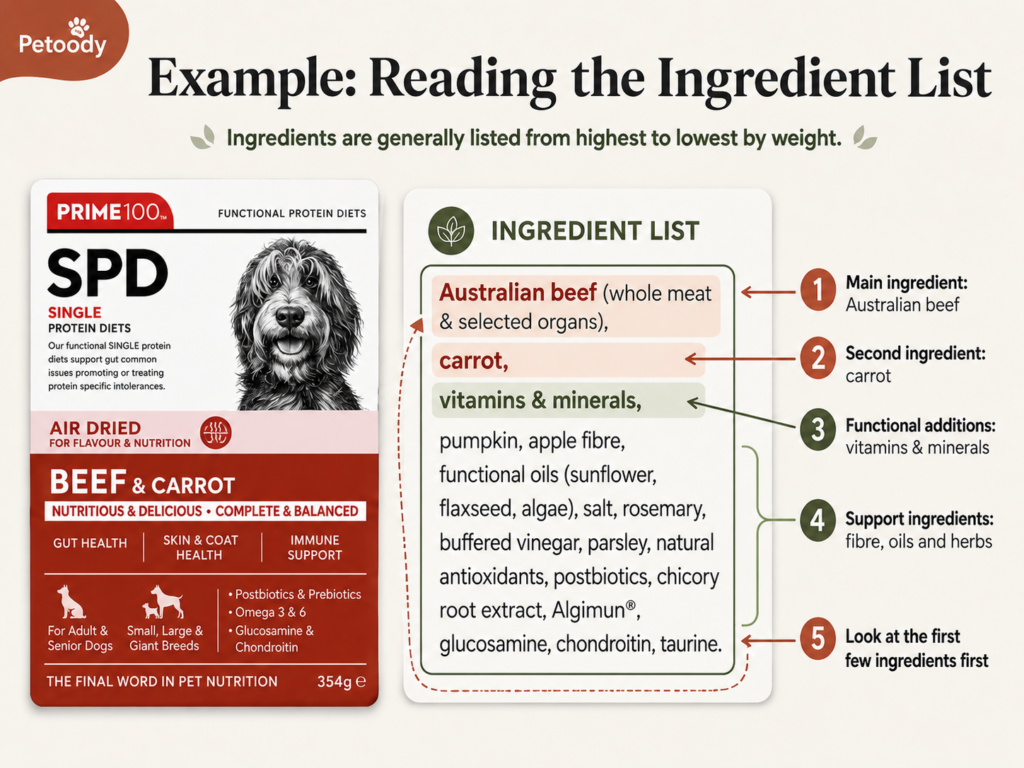
Pet food ingredient list showing ingredients listed in descending order by weight
3. Look for clearly identified ingredients
At Petoody, we generally prefer ingredient lists that are easy to understand.
Compare:
Beef, beef liver, beef heart
with a list containing broader or less-specific ingredient descriptions.
The first gives you a very clear idea of which animal proteins are present. That can be particularly useful if you are choosing treats for a pet with particular preferences or avoiding specific proteins.
However, a technical or unfamiliar ingredient name does not automatically mean an ingredient is poor quality.
Organs, animal co-products, vitamins, minerals and other functional ingredients can all have a legitimate place in pet food.
The question we prefer to ask is:
Can we understand what the ingredient is and why it is included?
That distinction is important.
Ingredient transparency is more useful than simply trying to divide every ingredient into “good” and “bad”.
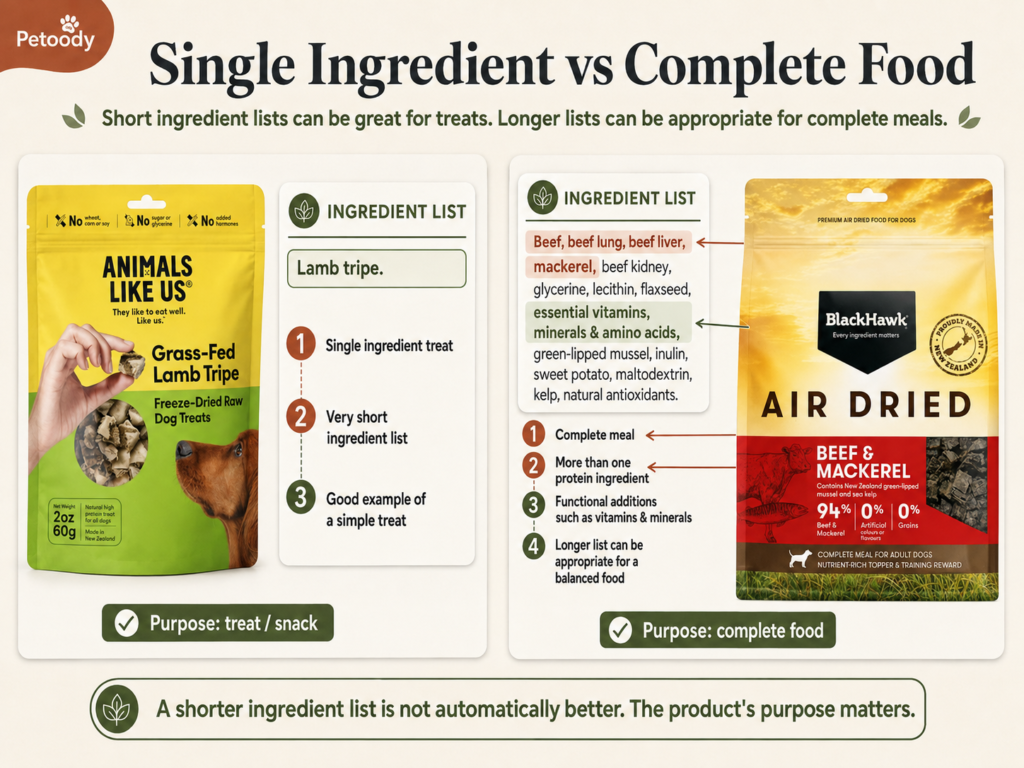
Comparing single ingredient pet treats with complete pet food ingredients
4. Ask what each ingredient is doing
One of the simplest ways to assess an ingredient list is to work through it and ask:
What purpose does this ingredient serve?
Some ingredients provide the main nutrition or flavour of the product.
Others may have a specific functional role.
For example:
- meat and fish can provide protein and fat
- organs can provide nutrients and flavour
- hay and grasses provide important fibre for rabbits and guinea pigs
- vegetables may provide fibre or contribute to the recipe
- vitamins and minerals may be required to make a food nutritionally complete
- oils may provide essential fatty acids
- natural or approved preservatives may help maintain freshness
- binders may help a treat hold its shape
- humectants such as glycerine can help keep softer treats moist
The presence of an additional ingredient does not necessarily mean it is unnecessary.
This is particularly important when comparing a treat with a complete food.
5. A long ingredient list isn’t automatically a bad ingredient list
It is easy to look at a packet containing one ingredient and another containing twenty and assume the shorter list must be better.
Sometimes simplicity is exactly what you want.
A dried piece of kangaroo, beef liver or fish skin may need only one ingredient. If that is what you are looking for, a single-ingredient dog treat makes the ingredient list particularly easy to understand.
A nutritionally complete pet food is different.
Complete foods need to provide a broad range of nutrients. That may require vitamins, minerals, oils, fibre sources and other functional ingredients in addition to the primary protein sources.
So a longer ingredient list does not automatically mean a lower-quality food.
Instead, look at why the list is longer.
There is a meaningful difference between complexity created by ingredients required for nutritional balance and complexity created by numerous sweeteners, colours, flavours, processing aids or other extras.
6. Ingredients worth looking at more closely
There are some ingredients Petoody pays closer attention to when reviewing products.
These can include:
- added sugars
- artificial colours
- artificial flavours
- excessive starches
- glycerine
- maltodextrin
- unnecessary fillers
- vague ingredient descriptions
Again, this does not mean that the appearance of one of these ingredients automatically makes a product harmful or unsuitable.
Some ingredients have legitimate functional roles.
Glycerine, for example, is commonly used as a humectant to help retain moisture and create the soft texture found in many semi-moist treats.
The question is whether the ingredient serves a useful purpose and how much unnecessary complexity it adds to the recipe.
This is one reason Petoody does not simply classify products as “good” or “bad”. Our Pure, Simple and Curated Clean Ratings are designed to show customers how simple or complex a product’s ingredient profile is.
7. Don’t assume “less processed” always means better
How a food is processed matters, but processing alone does not determine whether a product is appropriate for your pet.
Pet foods and treats may be:
- baked
- dehydrated
- freeze dried
- air dried
- cooked
- extruded
- canned
- raw
These processes affect texture, moisture, storage, convenience and potentially the nutritional characteristics of the finished food.
They can also have different food-safety implications.
For example, an air-dried product may look very different from traditional dry food, but the term “air dried” covers different manufacturing processes. If you are comparing the two, our guide to air-dried pet food vs kibble explains some of the differences.
Likewise, freeze-dried or dehydrated raw products need to be considered differently from fully cooked treats. If you use raw treats alongside a cooked diet, read our guide to feeding raw pet treats without feeding a raw diet.
The simplest processing method is not necessarily the best choice for every household or every pet.
8. Check whether it is a treat or a complete food
This is one of the most important pieces of information on any pet food label.
A product with an exceptionally simple ingredient list may be a great treat without providing everything your pet needs as its main diet.
For example, dried beef liver may contain only one ingredient.
That does not make beef liver a complete diet.
Likewise, a hay-based rabbit treat is not necessarily a substitute for the animal’s normal hay and complete feeding program.
Complete foods need to provide an appropriate nutritional balance for the species and life stage they are designed for. That frequently requires a more complicated recipe than a supplementary treat.
Always check the feeding statement and product directions rather than assuming that an ingredient list alone tells you how the product should be fed.
9. Consider your individual pet
There is no single ingredient list that is perfect for every animal.
A product can have a beautifully simple recipe and still be the wrong choice for a particular pet.
For example, a single-protein chicken treat might be extremely simple, but that simplicity is irrelevant if your dog cannot tolerate chicken.
The same principle applies to calorie density, fat content, texture and treat size.
Your pet’s:
- species
- age
- size
- existing diet
- sensitivities
- veterinary conditions
- chewing style
- individual preferences
all matter.
If your pet has a medical condition or is eating a veterinary therapeutic diet, discuss treats and dietary changes with your veterinarian.
10. Use the ingredient list as a tool, not a test
Reading pet food labels should make choosing food easier, not more stressful.
You do not need to recognise every vitamin, mineral or functional ingredient immediately.
Instead, start with a few simple questions:
What are the main ingredients?
Are they clearly identified?
Does the recipe make sense for my pet?
Are the additional ingredients there for an understandable reason?
Is this a treat, supplementary food or complete diet?
Is there anything included that I would prefer to avoid?
Once you begin looking at labels this way, comparing products becomes much easier.
How Petoody makes ingredient checking easier
At Petoody, we review the products we stock rather than expecting customers to analyse every packet from scratch.
Our Petoody Clean Eats Guide groups products into three ingredient-based ratings:
Pure — usually single-ingredient or very minimal products with little to no unnecessary extras.
Simple — products with recognisable ingredient profiles and a small number of functional additions.
Curated — products with more complex ingredient lists or processing-support ingredients that have still been reviewed and selected by Petoody.
Curated does not mean bad.
It simply gives you more information about the ingredient profile before you buy.
The aim is not to tell pet owners that there is only one correct way to feed their animals. It is to make it easier to understand what you are buying and choose products that fit your pet and your own feeding preferences.
The bottom line
A pet food ingredient list can tell you a lot, but it should be read in context.
Look at the main ingredients, how clearly they are described, what purpose the additional ingredients serve and whether the recipe is appropriate for its intended use.
Short ingredient lists can be wonderfully simple. Longer ones can be completely appropriate when they provide nutritional balance or serve clear functional purposes.
At Petoody, that is ultimately what we mean when we talk about clean pet food: ingredients that are understandable, thoughtfully selected and appropriate for the pet eating them.
If you want to explore the idea further, start with our complete guide to what makes pet food clean, then learn more about how Petoody’s Clean Ratings work.
Or explore our current ranges for dogs, cats and pocket pets.