
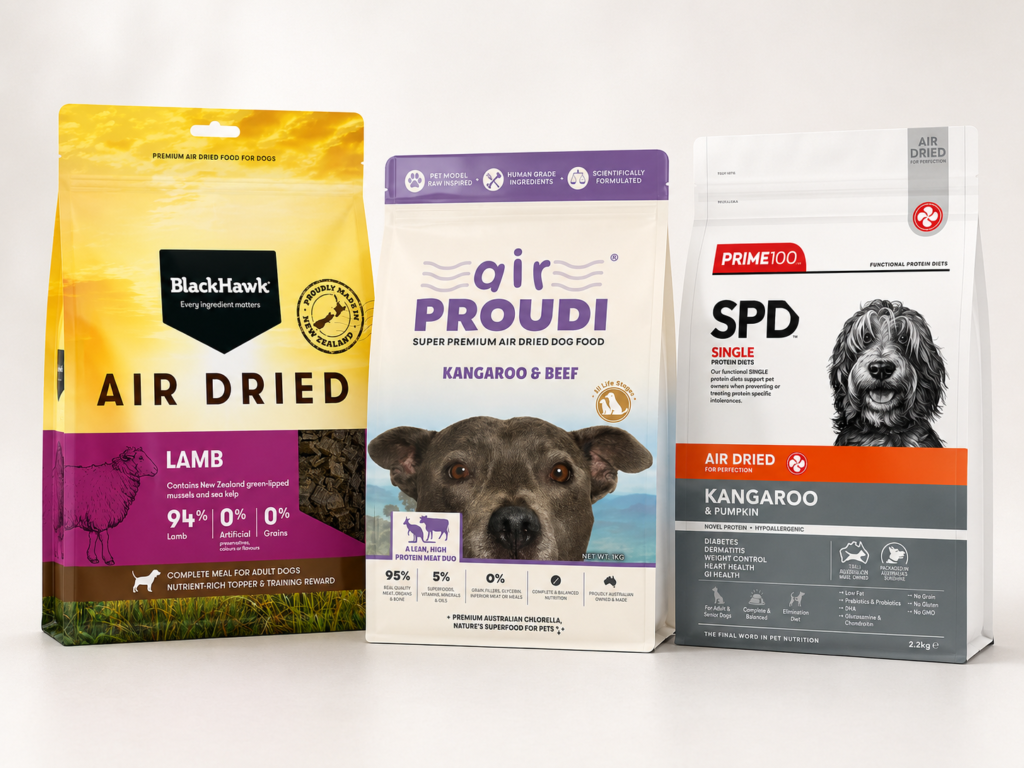
Air-dried pet food has become increasingly popular with owners looking for something that feels closer to fresh or minimally processed food while still offering the convenience of a shelf-stable product. It often comes in small, chewy or jerky-like pieces and may look very different from the familiar crunchy biscuits found in a bag of kibble.
But is air-dried pet food simply another type of kibble?
Not quite.
Although both air-dried food and kibble are generally classified as dry or low-moisture pet foods, they are produced using different processes. These differences affect their texture, density, feeding amounts and, sometimes, their ingredient composition.
Most importantly, the words air-dried, kibble, raw, natural and complete and balanced do not mean the same thing. The processing method tells you how the food was made, while a complete and balanced statement tells you whether it has been formulated to provide a pet’s full nutritional requirements.
What Does “Complete and Balanced” Mean?
A complete and balanced pet food is intended to provide all the essential nutrients a dog or cat requires when fed in the correct amount.
“Complete” means the food contains all the required nutrients, while “balanced” means those nutrients are provided in appropriate amounts and proportions. Nutritional requirements also differ between dogs and cats and between life stages such as growth, adult maintenance, pregnancy and lactation.
A food’s nutritional adequacy statement should indicate:
- Whether it is formulated for dogs or cats.
- Which life stage it is suitable for.
- Whether it is complete and balanced.
- Whether it is intended only for intermittent or supplementary feeding.
This distinction is especially important with air-dried products. Some are complete meals, while others are treats, toppers or complementary foods that cannot provide a balanced diet on their own.
Australian pet-food labelling standards provide for nutritional adequacy information to show whether a product is complete and balanced or intended to be fed with other foods. Commercial complete diets may be formulated using recognised nutritional profiles such as AAFCO or FEDIAF profiles.
Before using any air-dried product as your pet’s main diet, check the back of the package rather than relying only on words such as “premium”, “natural” or “nutritious” on the front.
How Is Kibble Made?
Most traditional kibble is produced through a process called extrusion.
The ingredients are ground and mixed before water or steam is added. The mixture is then moved through an extruder, where it is exposed to pressure, mechanical movement and heat. It forms a dough that is pushed through a shaped opening, cut into pieces and dried. Fats, flavourings, vitamins or palatants may then be applied to the outside.
Extrusion creates the light, crunchy and relatively uniform pieces that most owners recognise as kibble. It also cooks ingredients, gelatinises starch and helps create a shelf-stable product. Research shows that extrusion can improve the digestibility of starches and some proteins and help control undesirable microorganisms or naturally occurring anti-nutritional compounds. Manufacturers must also account for possible processing-related nutrient losses when formulating the finished food.
Kibble generally requires ingredients that help create and maintain its structure. These often include sources of starch, although the type and amount vary considerably between recipes.
How Is Air-Dried Pet Food Made?
Air-dried pet food is normally made by grinding or combining ingredients and then exposing them to circulating warm air over an extended period. Instead of being forced through an extruder and rapidly shaped under pressure, the food is gradually dried on trays, racks or conveyor systems.
Processing conditions vary between manufacturers, but published descriptions of air-drying commonly refer to warm-air temperatures of approximately 50–70°C over several hours or longer. The finished product often has a moisture level of around 10–14% and a denser, softer or jerky-like texture.
Because it does not undergo the characteristic extrusion and expansion process, air-dried food is not technically the same as kibble—even though both may be sold in bags and stored at room temperature.
Air-dried food is also not automatically raw. It has been dried using warm air, and the ingredients may have undergone additional preparation or microbial-control steps. The precise process should be confirmed with the manufacturer when this is important to an owner.
Air-Dried Food Compared With Kibble
The most noticeable difference is texture. Kibble is usually crisp, dry and uniform, while air-dried food is often denser, irregular and chewy.
Air-dried recipes may also contain a relatively high proportion of animal ingredients because they do not always require as much starch to create an expanded biscuit. However, this is not guaranteed. Some products still contain substantial amounts of potato, legumes, grains, fibres or processing ingredients.
Air-dried products may also include humectants such as glycerine to help retain softness and control moisture. These ingredients are not necessarily unsafe, but owners seeking a particularly simple formula may want to consider why they are included.
Processing alone does not determine the quality of a food. A well-formulated kibble from a manufacturer with strong nutritional expertise and quality-control systems may be a more appropriate choice than an air-dried product that is poorly balanced or unsuitable for the pet’s life stage.
Air-dried food should therefore be assessed as an individual product—not assumed to be healthier simply because it looks more like pieces of meat.
Potential Benefits of Air-Dried Pet Food
Convenient and shelf-stable
Air-dried food provides some of the convenience of kibble without requiring freezer space or daily thawing. Most products can be stored at room temperature before opening, although owners should always follow the manufacturer’s storage directions.
Nutritionally concentrated
Removing much of the water creates a concentrated food. This means pets may receive a relatively large number of calories and nutrients from a small volume.
This can be helpful for dogs or cats that struggle to eat large meals, but it also makes careful portion control important.
Appealing texture and aroma
The meatier smell and chewy texture may appeal to pets that are reluctant to eat traditional kibble. Air-dried food can sometimes be used as a complete diet or, where appropriate, as a highly palatable addition to another diet.
Easy to portion and use
The pieces are generally easy to serve, travel with and place in food-dispensing toys. Some complete and balanced air-dried foods can also be used as training rewards, provided the amount used is deducted from the pet’s normal daily ration.
A different option for mixed feeding
Owners may combine an appropriate complete air-dried food with complete wet food or kibble. Mixing formats can provide greater variety in texture while still allowing the overall diet to remain nutritionally balanced.
How Should Owners Feed Air-Dried Food?
Begin by following the feeding guide provided for that specific product. Do not use the feeding amount from a previous kibble, as the two foods may contain very different numbers of calories per gram.
Because air-dried food can be energy-dense, the recommended serving may look surprisingly small. This does not necessarily mean the pet is being underfed. What matters is the amount of energy and nutrition in the portion—not how full the bowl appears.
Weighing the food in grams with a kitchen scale is generally more accurate than measuring irregular pieces by volume.
Feeding guides remain a starting point. The correct amount will depend on the pet’s:
- Body weight and body condition.
- Age and life stage.
- Activity level.
- Neuter status.
- Metabolism.
- Health and medical requirements.
- Treats and other foods received during the day.
Monitor the pet’s body condition and weight, then adjust the daily quantity where necessary. Pet-food feeding directions are guidelines and may need to be modified for an individual animal.
Can Air-Dried Food Be Rehydrated?
Some air-dried foods may be softened with warm water, but owners should check the manufacturer’s instructions first.
Adding water may make the meal easier to eat and can increase overall water intake. Once water has been added, however, the food should be treated more like a fresh meal. Do not leave moistened food sitting in the bowl for long periods, and discard uneaten portions promptly.
Air-dried food contains much less water than canned, fresh or raw food. Dogs and cats should therefore always have access to clean drinking water. Owners of cats, pets that drink poorly, or animals with urinary or kidney conditions should discuss the most appropriate diet and moisture intake with their veterinarian.
Transitioning to Air-Dried Food
Even a high-quality food can cause digestive upset when introduced too quickly.
Transition gradually by mixing increasing amounts of the air-dried food with decreasing amounts of the old food. A transition of approximately 7–14 days suits many pets, although sensitive animals may require longer. It is recommended gradually changing diets over approximately 7–14 days.
During the transition, monitor:
- Appetite.
- Stool consistency.
- Vomiting or excessive gas.
- Skin or ear irritation.
- Body weight.
- General comfort and energy.
Persistent digestive upset, itching, loss of appetite or other concerning changes should be discussed with a veterinarian.
What Should Owners Consider Before Feeding It?
Calorie density
Air-dried food can contain significantly more calories in a smaller serving than owners expect. Free-pouring it into the bowl can quickly lead to weight gain.
Compare products using the stated kilocalories per kilogram or per gram rather than relying only on the recommended number of cups.
Fat content
Many meat-rich air-dried recipes are relatively high in fat. This may suit some active or underweight animals but may be inappropriate for pets that need a lower-fat diet, have previously experienced pancreatitis or gain weight easily.
Life-stage suitability
An adult-maintenance food may not be appropriate for a growing puppy or kitten. Similarly, an “all life stages” formula can be more nutrient- and calorie-dense than a sedentary adult pet requires.
Individual health conditions
High-protein or meat-rich marketing does not mean a food is suitable for every animal. Pets with kidney disease, urinary problems, gastrointestinal conditions, food allergies or other medical needs require individual veterinary guidance.
Moisture intake
Air-dried food is still a low-moisture food. Owners should not assume that its meat-like appearance means it provides the hydration of fresh, canned or raw diets.
Cost per day
Air-dried food can appear expensive by bag weight, although the smaller serving size may partially offset this. Compare the actual daily feeding cost for your pet rather than comparing package sizes alone.
Ingredients and formulation
Look beyond the first ingredient. Consider the entire recipe, calorie content, fat level, added vitamins and minerals, processing aids and the nutritional adequacy statement.
A complete and balanced food may legitimately contain supplemental vitamins, minerals and amino acids. These help ensure the finished product provides all required nutrients consistently.
Dental care
Neither ordinary kibble nor air-dried food should automatically be considered a replacement for dental care. Certain specially designed dental diets and chews have demonstrated effects, but texture alone does not guarantee that a food will adequately clean the teeth.
Is Air-Dried Food Better Than Kibble?
Air-dried food is not simply kibble with a different name—but it is also not automatically better.
It provides owners with another useful feeding format: shelf-stable, compact, often highly palatable and sometimes made with a greater proportion of animal ingredients. For some pets and households, it may offer an appealing balance between the convenience of kibble and the texture of less heavily dried foods.
The best choice will ultimately depend on the individual product and the individual pet.
Whether choosing air-dried food, kibble, wet food, fresh food or a combination, owners should prioritise:
- A clear complete and balanced statement.
- Suitability for the pet’s species and life stage.
- Transparent feeding and calorie information.
- Responsible manufacturing and quality control.
- A formulation that supports the pet’s individual health needs.
- An amount that maintains a healthy body condition.
Air-dried complete and balanced food can be fed as a pet’s main diet when it is appropriately formulated and fed according to directions. The key is to recognise that its nutritional suitability comes from the complete formulation—not simply from the fact that it has been air-dried.